I (Nicole) grew up on the western coast of Canada, where the mountains meet the sea, and it is impossible not to be awed, daily, by the sheer magnificence and beauty of our world. Whales are not an unusual sight.
Whales in the city
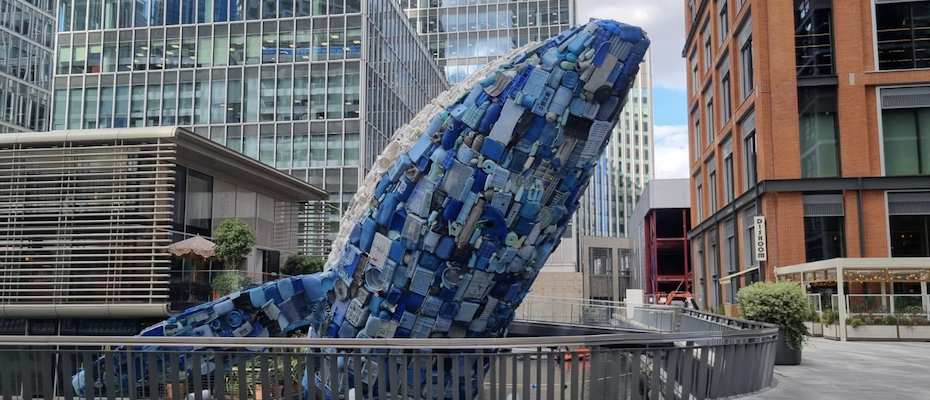
The picture for this blog post was taken in central London, where the breaching whale, outlined by the skyscrapers, makes us pause and consider both the incongruity and the possibility of it. For me, this blue plastic cetacean evoked a series of emotions- joy at the creative wonder of it, surprise due to its location, homesickness, sadness because of what it speaks to (the sheer amount of plastic in our oceans) and hope.
Hope, because more and more people are finding ways to help us (re)connect with nature. This emotional connection to the world around me is my connection to nature.
Oh I do like to be beside the seaside
I (Bee) grew up in different homes along the south coast of the UK. I have spent much of my life in Bournemouth, known for its beautiful ‘blue flag’ beaches. The sights, sensations, and sounds of the sand and sea have always been soothing to my soul. Over the summer, Bournemouth attracts hordes of holiday makers, many of whom have a tendency to leave their litter behind, rather than respect and protect the pristine nature of our coastline.
This year, I visited Ghana, where a visit to the beach evoked an understanding of the problems of plastic pollution in a way that I will never be able to forget. The sheer amount of plastic bags and bottles which were being burned on the beach (sending smog to the skies), being buried into the sands, and being washed up into the waters was overwhelming. In a similar way to Nicole, my emotional, psychological and physical connection to wildlife and places of natural beauty is a deep one, and this influences my personal and professional practice.
(Re)connecting to nature
Nature connectedness is a psychological construct that refers to the felt relationship that we have with nature. It can be understood as how much a part of nature we feel ourselves to be. It is a modern, Western, industrialised way to view nature as ‘other’ than us. Indigenous peoples, for millenia, have seen humanity as intrinsically bound to the earthly systems, the natural world, that sustain us (Chrona, 2022). Humanity has always learned with, through, and from the natural world.
There is a narrative, and a realisation, that children and young people today are growing up more and more disconnected from nature (Louv, 2005). This sits within the current climate crisis, and the increasing number of children and young people who have climate anxiety, despondency and despair over the state of the natural world they are set to inherit (Edgington, 2024; Mental Health UK, 2023).
Why it matters
Feeling connected to nature has been linked to:
- improved wellbeing
- increased pro-environmental behaviours, and
- improved behaviours for learning (e.g., social skills, self-regulation, resilience, motivation, independence, attention, and problem-solving) (Harris et al., 2025).
Increasing how connected our children feel to nature therefore has powerful outcomes at personal, societal, and global levels. It matters and it makes a difference.
Supporting the growth of nature connectedness in schools
There is disparity, however, amongst our children in terms of who has access to nature and who is supported to develop nature connectedness. Research has shown that children and young people in more deprived areas are nine times less likely to have access to green space (Moula et al., 2023). Research has also shown that there are a multitude of simple, low-cost, easily implementable activities that schools could introduce into their curricula to foster nature connectedness (Harris et al., 2025). Since most children go to school, making time for them to connect with nature outdoors would render accessible to everyone the great benefits of connecting with themselves, with others, and with wildlife.
Suggested outdoor activities include:
- connecting with nature using your senses, and reflecting on how it makes you feel
- creative activities
- getting your hands dirty- gardening, and making and playing within nature
- walking and reflecting in nature.
What can EPs do?
Educational Psychologists are in a privileged position in that we can help to influence the systems and psychologies that shape our schools. More and more schools, especially primary schools, are taking some of their lessons outside. They are also greening and naturalising their school grounds, building raised beds, and making woodlands and ponds that are accessible to their young people. Moreover, schools are required to have a Climate Action Plan in place by this month (September 2025), as part of the Government’s 2022 Climate and Sustainability Strategy (DfE, 2023). We could work with a school’s sustainability lead to incorporate opportunities for nature connectedness into their wider Climate Action Plan.
EPs (and TEPs) are also in a position to evidence and evaluate the effects of nature connectedness upon children’s learning, emotional regulation, behaviour, and wellbeing. At the University of Southampton, we have been using participatory research and development approaches to evolve curriculum resources, measures, and examples of effective practice in this area. For example, we have been trialling our Wild InnerSense Educational Resource (WISER), which is an outdoor programme utilising 12 different senses to support young people to connect more deeply with their unique, individual nature and the great nature which sustains and surrounds us all.
Nature connectedness is more than simply time spent in nature. As EPs, we can guide our schools in how they use these spaces, we can bring nature-connection activities into our recommendations for supporting the young people that we work with, and we can remind teachers and parents how to support the development of nature connectedness. The young people that we work with need us to give them the time and the space to discover the incredible world on their doorsteps- from whales in their cities to centipedes in their wellies.
Additional information and resources can be found at:
- Example nature connectedness activities for schools
- Nature connection in schools – a ‘how to guide’ for all things nature connection in school
- The nature connection handbook – a guide for increasing people’s connection with nature, from the University of Derby
- The National Education Nature Park – The National Education Nature Park programme empowers children and young people to make a positive difference to both their own and nature’s future.
- The Educated Guess Podcast – episode 1 explores Climate courage
- Mind the Kids – Rewilding Childhood: Why Nature Matters in Mental Health
- Aoife McNally’s blog, Is it time EPs advocated for children and young people to have increased contact with nature?
If you are an EP or TEP and this area of work interests you, a group of us have formed a working group called EcoEdPsychs. Please drop us an email if you would be interested in joining