Children and young people experiencing Emotionally Based School Non-Attendance (EBSNA) continue to present significant challenges for education settings and families.
Persistent absence rates remain high, and while recent policy guidance (Working Together to Improve School Attendance; DfE, 2024) promotes early intervention, there is still no nationally agreed framework for supporting children and young people experiencing EBSNA. Historically, research and practice have relied heavily on adult perspectives – parents, teachers, professionals, often leaving pupil voice underrepresented or filtered through others.
EPs are well placed to address this gap. Understanding how pupils themselves construe education can provide valuable insight into what supports engagement and wellbeing. However, eliciting these views is not straightforward. For pupils whose anxiety or emotional distress makes school attendance difficult, traditional interviews can feel inaccessible or overwhelming. This raises an important question: how do we create safe, meaningful opportunities for pupils to share their perspectives?
This article introduces a participatory tool developed through research and practice, and explores how it can help EPs create more accessible opportunities for pupil voice.
Developing the ‘Ideal Education’ Tool
Inspired during her time as a Trainee EP, Dr Katie Hughes developed the Ideal Education tool after encountering several work placement experiences related to situational mutism. The tool is designed to help secondary-aged pupils experiencing Emotionally Based School Non Attendance (EBSNA) articulate what their ideal, and non-ideal education looks like, and it can readily be adapted for younger children. Katie’s doctoral research drew on this tool through interviews with six young people aged 11–16 within a local authority context, exploring their experiences of EBSNA and their visions for more supportive educational environments.
The Ideal Education tool used in this study was developed as an adaptation of the well‑established Drawing the Ideal School activity, originally created by Williams and Hanke (2007) and rooted in Personal Construct Psychology (Kelly, 1955). The original Ideal School tool was designed to elicit pupils’ subjective constructs through a dichotomous “ideal” versus “non‑ideal” format, enabling them to express their experiences and preferences visually and verbally.
This approach built on earlier PCP-informed participatory approaches, including Ravenette’s “drawing and its opposite” technique, which emphasised contrastive meaning-making, and Heather Moran’s Drawing the Ideal Self activity, which both emphasise contrastive meaning‑making and support children to explore their internal worlds in accessible, creative ways.
Katie took further inspiration from Higgins (2022), who in their doctoral thesis developed and applied the Ideal School tool with autistic pupils experiencing EBSNA. Their work demonstrated how valuable flexible, visual, and pupil‑led methods can be for children and young people who are emotionally vulnerable or who struggle to engage in traditional dialogue-based approaches.
Building on this lineage, the current approach reconceptualised the activity as the Ideal Education tool, broadening its focus beyond school alone to encompass the wider educational realities of children and young people experiencing EBSNA. This includes home learning, alternative provision, and hybrid arrangements – an intentional shift that avoids centring “non-attendance” as a deficit and instead recognises the diverse contexts in which learning can occur.
In evolving the tool, Katie retained the core PCP principles that underpin the original approach, particularly the use of an ‘ideal’ versus ‘non‑ideal’ comparison to help pupils express what works for them and what does not. At the same time, she incorporated additional accessibility features, such as prompt cards and a simple scaling task, to support engagement for pupils experiencing anxiety, communication differences, or prolonged periods out of education.
As a result, the Ideal Education tool represents both a continuation and an expansion of the ‘ideal school’ tradition, grounded in the same constructivist roots, but adapted for the contemporary landscape of EBSNA and firmly centred on amplifying pupil voice in the redesign of emotionally attuned educational experiences.
How Does It Work?
The tool has two steps:
1. Exploring Non-Ideal and Ideal Education
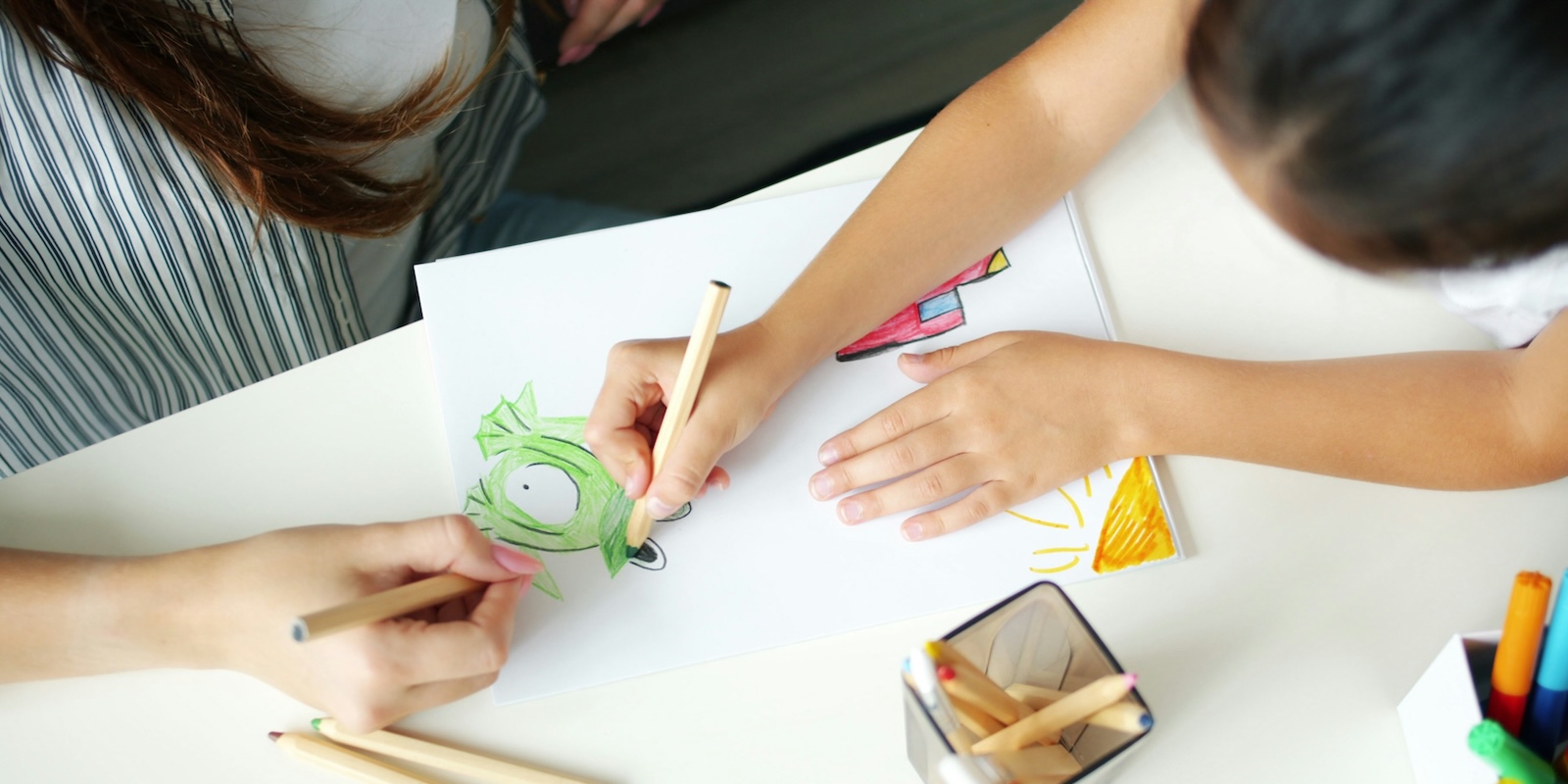
Pupils are invited to draw, write, or verbally describe their non-ideal and ideal education. Visual prompt cards and semi-structured questions support reflection across four domains:
- Environment (physical and sensory)
- People (teachers, peers, family)
- Learning (styles, interests, aspirations)
- Structure (rules, routines, autonomy)
With the Ideal Education tool, visuals are used flexibly to support conversation rather than as a fixed resource; example materials can be made available from the authors on request.
2. Scaling and Bridging
Pupils position their current education on a 0–10 scale between non-ideal and ideal, then respond to the prompt:
“What would move your current education one step closer to your ideal?”
This question generates practical, pupil-led suggestions for change.
Sessions are flexible and multimodal, combining visual and verbal elements to reduce reliance on spoken language. This approach is particularly helpful for young people experiencing situational mutism or elevated anxiety, offering alternative routes for participation and expression.
Together, these steps create a structured yet flexible way of understanding how a young person experiences education – both the barriers they are experiencing, and what would make ‘education’ feel more possible.
Katie’s Reflections on Using the Ideal EducationTool
Katie shared two key insights from her research experiences:
- On the drawing element:
“The drawing element of the ‘Ideal Education’ activity proved less effective than anticipated… the prompt to ‘draw what your ideal/non-ideal education looks like’ appeared too abstract or unfamiliar. As a result, participants often needed earlier verbal prompting than planned, with most choosing to respond verbally rather than engaging with the drawing activity.”
- On family presence:
“While their involvement appeared to increase pupil comfort and reduce anxiety, it may also have influenced how pupils shared their views… I attempted to mitigate this by addressing questions directly to the pupil and, where needed, gently prompting with phrases such as, ‘others might feel differently, what do you think?’”
These reflections highlight the importance of flexibility and sensitivity when using participatory tools with pupils experiencing EBSNA.
What Did Young People Tell Us?
Using Reflexive Thematic Analysis, four overarching themes were evident:
1. Adaptive Educational Structures
Flexible timetables, later start times, shorter lessons, and reduced transitions were valued. Homework was consistently described as stressful, blurring boundaries between home and school.
2. Relational Safety and Emotional Support
Ideal teachers were described as kind, authentic, and understanding – particularly of neurodiversity. Pupils emphasised the importance of calm, sensory-safe environments and positive peer relationships.
3. Autonomy, Fairness, and Pupil Voice
Pupils wanted freedom of movement, access to basic needs without permission, and co-constructed rules. Uniform policies were often perceived as restrictive, with comfort linked to concentration and wellbeing.
4. Purposeful and Personalised Learning
Creative, practical, and interest-based learning was preferred over passive formats. Pupils highlighted the importance of future-oriented content, including life skills and career pathways.
Practical Tips for EPs and TEPs
If you’re considering using the Ideal Education tool in practice:
- Prepare visual prompts to scaffold discussion – especially for young people who find open-ended tasks challenging.
- Offer multiple modes of expression (drawing, writing, verbal) and let young people choose what feels safest.
- Build in flexibility – sessions may need to be shorter, spaced out, or adapted for home settings.
- Be mindful of family presence – it can support engagement but may influence responses; use gentle prompts to centre the young person’s voice.
- Use the scaling question (“What would move your current education one step closer to your ideal?”) to generate practical, young person-led suggestions for change.
Looking Ahead
Future developments could include digital adaptations for remote engagement and co-designed visual prompts to scaffold reflection. Embedding these approaches within EP practice aligns with our professional commitment to inclusion, participation, and social justice.
References
Butler, R. & Green, D. (2007). The child within: Taking the young person’s perspective by applying Personal Construct Psychology. Wiley.
Department for Education. Working Together to Improve School Attendance (statutory guidance, applies from 19 August 2024).
Higgins, C. (2022). Exploring the school experiences of autistic pupils experiencing Emotionally Based School Non‑Attendance (Unpublished doctoral thesis).
Kelly, G. A. (1955). The Psychology of Personal Constructs.
Moran, H. (2001). Who do you think you are? Drawing the Ideal Self: A technique to explore self‑concept in young people. Educational Psychology in Practice, 17(4), 311–320.
Ravenette, T. (1999). Personal construct theory in educational psychology: A practitioner’s view. Wiley.
Williams, J. M., & Hanke, D. (2007). ‘Drawing the Ideal School’: A projective technique for exploring pupils’ views of school. Educational Psychology in Practice, 23(4), 305–319.