
Our Community Educational Psychology Service (CEPS) in North East Lincolnshire has worked to make our EHC Needs Assessments more collaborative, transparent and, most importantly, even more centred around children. An exciting development in this area is how we facilitate person-centred consultation meetings.
Person-centred planning is a collaborative approach that supports people to plan for their future by focusing on what matters to them now and their aspirations ahead, involving those who know and support them best (Sanderson, 2000).
Person-centred consultation meetings as part of the EHC assessment
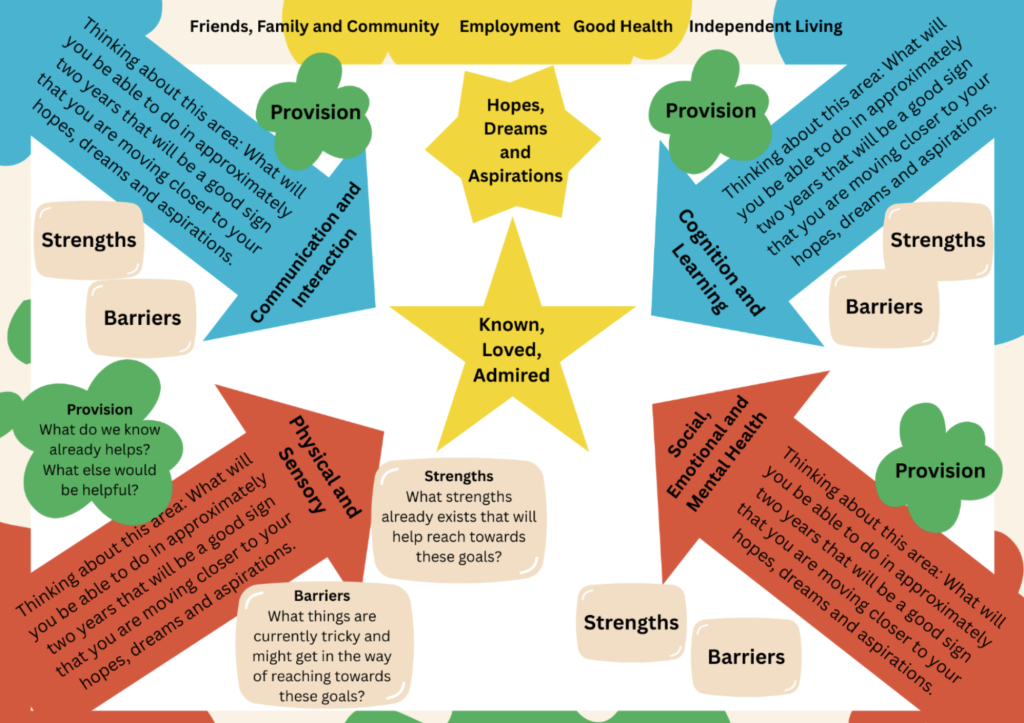
Our values led meetings adapt the PATH (Planning Alternative Tomorrows with Hope) creative planning tool developed by O’Brien, Forrest and Pierpoint in the 1980s (as cited in Inclusive Solutions, n.d.), incorporate the Preparing for Adulthood outcomes (National Development Team for Inclusion, NTDi, n.d.), and align with the four key areas of the Special Educational Needs and Disabilities (SEND) Code of Practice (Department for Education & Department of Health, 2015).
Person-centred meetings draw on both constructivist learning theory and humanistic psychology. Plans are co-constructed through dialogue and reflection, grounded in the person’s lived experience, while prioritising autonomy, empathy, and the belief that individuals are experts in their own lives. In preparation for the meeting, we analyse information from the Education, Health and Care Assessment Request to develop an initial psychological formulation to support the consultation.
We value children’s participation in their own meetings wherever possible, while recognising that this can sometimes feel overwhelming. Where this is the case, we meet with children beforehand to ensure their views, wishes, and feelings are represented clearly. Wherever possible, we also ensure that the adults most closely involved in supporting the child are present, enabling the inclusion of diverse perspectives and a more holistic understanding of the child’s strengths and needs.
The voices of the child and their parents or carers are fundamental in co-constructing goals, ensuring that outcomes are aspirational, realistic, and lead to appropriate support that empowers children to live the life they feel is right for them. Inviting all participants to share at least one objective they hope to achieve from the meeting establishes a strong foundation for co-production.
Using large sheets of paper displayed on walls, or digital formats, we support collaboration by visually recording the perspectives of all participants across key aspects of the child’s lived experience (Figure 1). This approach helps make potentially complex discussions more accessible, fosters stronger relationships, reduces power imbalances, reframes challenges in more positive ways, and bridges the gap between professional assumptions and the child’s lived reality.
Revisiting each participant’s initial objective at the end of the meeting supports reflection on its effectiveness and promotes accountability within CEPS. To conclude, the facilitator photographs the visual record and invites participants to do the same, ensuring immediate access to the ideas and supporting the development of sustainable practices for the child.
Children and families experiences of our person-centred EHC consultation meetings
Following participation in our person-centred consultation meetings, we recorded the views of children, parents, carers and professionals about how the meetings felt and what aspects they found helpful. We then reviewed this feedback using thematic analysis to identify patterns of meaning across responses, drawing on the approach outlined by Braun and Clarke (2006).
We identified several inter-related themes describing the meetings as emotionally safe, inclusive, transparent, and engaging, enabling meaningful collaboration and shared understanding.
Theme 1: Emotional safety, comfort and reduced anxiety
Participants reported feeling comfortable and reassured, even when initially uncertain or apprehensive. Parents noted that any early doubts were quickly alleviated, supporting their sense of emotional safety and enabling open and confident engagement.
Parents reported feeling able to comment freely and openly, with reassurance that their contributions were valued and respected. One parent described feeling “very dubious going into the meeting” but then “couldn’t have felt more at ease”, suggesting that the process actively reduced anxiety and built trust over the course of the consultation.
Theme 2: Feeling heard and valued through inclusive participation
A strong theme across responses was the experience of being listened to and having all views acknowledged. Parents emphasised that everything they said was “listened to,” while professionals reflected that they “don’t often have the opportunity to sit and share, it’s been useful”, highlighting the value of creating a space where perspectives can be shared and built upon collaboratively.
Meetings were described as clearly child-centred, with a shared focus on how best to support the child moving forward. This fostered a sense of partnership between families and professionals, rather than decision-making being led by a single voice or system.
Theme 3: Transparency and shared understanding through visual methods
The visual nature of the meetings emerged as a distinct and valued theme. Participants highlighted how seeing information recorded live and visibly throughout the meeting supported clarity, understanding, and transparency.
Parents valued having “everything that had been said written in front of us”, which reduced the likelihood of misinterpretation. SENDCOs and other professionals similarly praised the visual presentation of outcomes, noting that it helped all participants follow the discussion and feel included in the process.
Theme 4: Natural, conversational and engaging process
The meetings were frequently described as engaging, informal and conversational, rather than procedural or clinical. Parents noted that the discussion “flows more naturally” and feels like a genuine conversation rather than a formal assessment meeting.
This relational style appears to support authentic contributions and help participants feel at ease, promoting meaningful dialogue rather than guarded responses.
Theme 5: A positive and refreshing alternative to traditional processes
Several participants described the approach as a “breath of fresh air”, indicating that it contrasted positively with more traditional or deficit focused statutory processes. Professionals reflected that the meetings provided a valuable opportunity to truly get to know the child, rather than focusing solely on difficulties or paperwork.
Feedback from education staff and the young person reflected positive surprise and approval, suggesting the approach exceeded expectations and was experienced as better than anticipated.
Challenges we have encountered during our person-centred EHC consultation meetings
Allocating two hours for person-centred meetings can initially prompt surprise from SENDCOs, given the time pressures of their role. Over time, increased familiarity with the format and its effectiveness has led to greater acceptance of our approach. Investing this time upfront provides a platform that supports cultural change in schools, leading to more consistent, equitable outcomes for children.
Challenges also arise when participants are invited to reflect spontaneously on a child’s experiences, or when parents feel overwhelmed discussing sensitive issues amongst professionals. In response, we adopt a flexible approach, including offering separate meetings with parents or carers where needed to support comfort and meaningful engagement.
Working towards becoming a Borough of Belonging
The person-centred approach has been adopted widely across SEND in North East Lincolnshire.
As we continue developing this work our key learning remains that person-centred EHC assessment is not simply about using a particular tool or format, it is about creating collaborative, transparent spaces where children’s voices are meaningfully held in mind, families feel included, and professionals can think together in ways that lead to more equitable and sustainable support.
For us, bringing person-centred planning into EHC needs assessments is one important way of making statutory processes feel more human, more relational, and more firmly rooted in what matters most to children and those who know them best.
References
Braun, V., & Clarke, V. (2006). Using thematic analysis in psychology. Qualitative Research in Psychology, 3(2), 77–101. https://doi.org/10.1191/1478088706qp063oa
Department for Education & Department of Health. (2015). Special educational needs and disability code of practice: 0 to 25 years. https://assets.publishing.service.gov.uk/media/5a7dcb85ed915d2ac884d995/SEND_Code_of_Practice_January_2015.pdf
Inclusive Solutions. (n.d.). PATH (Planning Alternative Tomorrows with Hope). https://www.inclusive-solutions.com/pcp/path
National Development Team for Inclusion. (n.d.). Preparing for adulthood. https://www.ndti.org.uk/programme/preparing-for-adulthood/
Sanderson, H. (2000). Person-centred planning: Key features and approaches. Joseph Rowntree Foundation.