
In the light of the current special educational needs and disabilities (SEND) reforms and the launching of the ‘Experts at Hand’ model in September 2026, it is important to consider where this expertise and support could be located.
Roadmaps – a peer parent support group
I, Anita, have worked with a community-based parent peer support group called ‘Roadmaps’ for parents of children with special educational needs and disabilities for the last four years.
It is a mixed parent group, in all the mothers, come from a diverse range of linguistic, cultural, immigrant status (e.g. 1st or 2nd or 3rd generation immigrants) and religious backgrounds. They are all from an under-served community in Winson Green, Birmingham, many living in temporary accommodation and are in the top 10% of areas facing multiple deprivations. This is an area that is not commonly researched, as it is a group that crosses traditional boundaries in terms of religions, cultures and languages.
Exploiting the potential of Experts at Hand
The Experts at Hand (EaH) model (DfE 2026) states ‘Rather than children having to wait for support elsewhere, experts will work alongside staff in the places where children already learn’.
It positions professionals as the main source of knowledge, guidance and solutions so that education professionals access expert advice when needed and the guidance suggests it is situated in schools and early years settings. In addition, one of the aims of the experts at hand model is co-producing inclusive support with families, including resources, workshops and approaches that help parents understand their child’s needs and ensure their voices shape practice and provision (DfE 2026).
However, this approach overlooks the existing knowledge on the impact of peer support groups for parents of children with special educational needs and disabilities (SEND).
What we already known about peer parent support groups
Mueller, Milian, & Lopez (2009) found parents described the support group feeling like a family, particularly in the absence of any other networking opportunities for same language speakers and feeling alone in the special education system. This allowed them to share similar experiences that no one else understands, which led to trusting relationships and feeling they were all equal.
Parents reported their experiences were normalised, reducing distress and feelings of guilt or blame, and improving wellbeing and coping. They experienced increased confidence, empowerment, and a sense of control as parents developed advocacy skills, which provided hope and reassurance. This also reflected a sense of belonging, connection, solidarity, and support that felt like a family through their shared experience and mutual understanding.
Chakraborti et al. (2021) note that participation in parent peer support groups was influenced by ethnicity, e.g., in US studies participants are less likely to be African-American than Euro-American. Additional outcomes of the groups identified by parents across studies included having access to a source of information or strategies from relevant professional input (e.g., guest speakers, services) and practical advice or emotional support from other parents.
Both studies highlighted the importance of culturally responsive and accessible peer support, particularly for minoritised parents. The findings indicated that information and assistance the parents were missing from the school system were offered through their group, which has relevance for the framing of the EaH offer.
What parents get from belonging to a peer support group
The key findings were based on the parents voting for the outcomes that were most relevant to them. In order to create accessible findings, these words were formed into a word cloud as shown below. The parents chose for it to be in a heart!
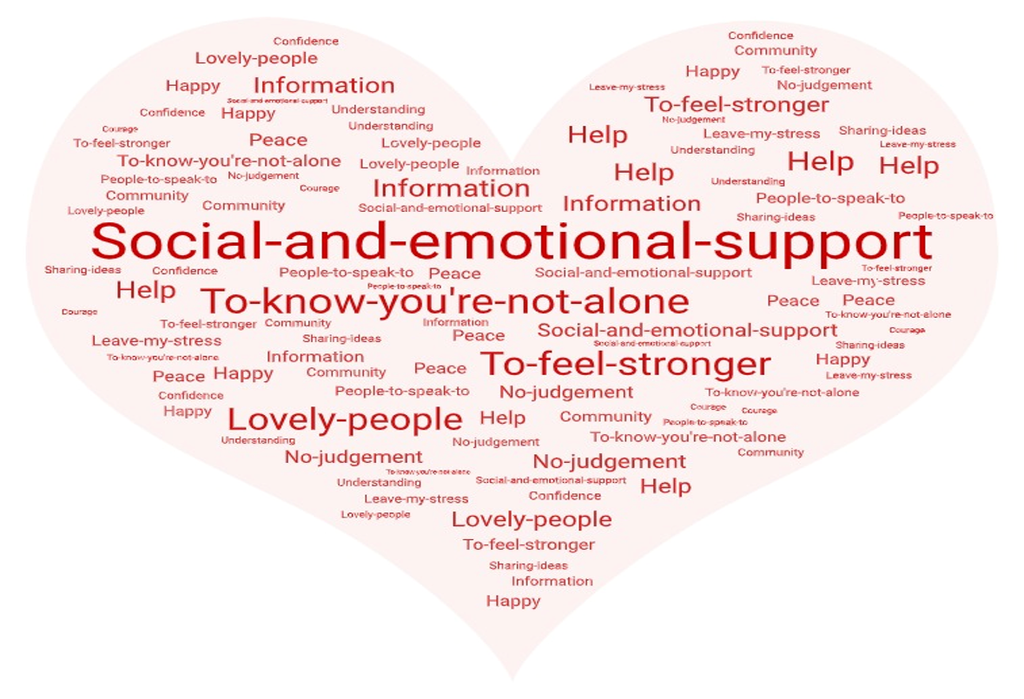
Our thematic analysis of the data led to four main themes, which are explored below incorporating quotes from the parents (using pseudonyms) to illustrate the themes.
Being part of a non-judgemental group
This was the most frequently referred to theme. Parents highlighted the value of being able to open up without criticism or stigma due to facing similar challenges. Claire and Maryam discussed being “in the same boat” as the other group members. Another said “it shows me I’m not alone; people understand. They won’t judge me if I’ve had a bad day.” Kiran further illustrated this, saying you “forget about your own pain when comparing” to the other families.
Gaining social and emotional support
Parents spoke of the importance of building connections with people who understood, and how the peer support group provided comfort to each other. Nafisah stated that they leave the support group feeling like “a weight has been lifted off your shoulders”. Odeh further added: “overwhelming sense of peace, puts me at ease”
Sharing information and ideas
Parents shared the importance of practical guidance for everyday issues and situations, from others who had been through similar experiences. Maria, the charity lead who facilitated the group, felt that the “most exciting thing is the power the parents have and [how they] use it to help each other”. Selina agreed: “If I need some guidelines, [I] can come and discuss.” Four parents (Neelam, Malala, Amy and Miriam) referred to the group being “very helpful” any time they had a problem.
Empowerment
Parents highlighted that their confidence was boosted and it gave them continued strength to fight the everyday battles. Selina stated: “every time I leave, it gives me courage and motivation.” Kiran put it simply: “it gives you power”.
The findings from this small-scale research reinforce previous findings that the primary outcomes of support groups for parents relate to the social and emotional help that members get from each other. They are seen as a source of valuable guidance, advice and information. An important factor appeared to be that they shared common ground, which enabled them to have a mutual understanding of each other’s circumstances.
The value of taking the Experts at Hand offer into the community
The implication for educational psychology is to consider widening the contexts for the EaH offer to go beyond schools and early years settings, to support parents in the community, through joining or establishing parent peer support groups.
An effective framing for the EaH model could be a peer-led or co-produced support model, where knowledge is shared horizontally between parents alongside bringing professionals into communities, as well as schools and early years settings, so that expertise can be shared and accessible in fair, equitable ways.
Parent peer groups can provide mutual support and understanding as “someone who has been there”. This sense of solidarity, belonging and normalisation lends itself to empowerment rather than dependency on professionals.
More information about what we did
Preeya joined the peer support group, ‘Roadmaps’, as a researcher and explored the outcomes with 16 parents in a focus group, asking them to reflect on the question, ‘What they took away from the group in their bag?’. Two additional mothers asked for their views to be included at a session later in the week. In order to make this accessible to those who were shy or had English as an Additional Language, other members of the group acted as interpreters and the key outcomes generated on posters were scribed and then used for a voting system.
We adhered to BPS (2021) ethical guidelines for this research study and had ethical approval from the University of Birmingham. The most common languages spoken by members of the group were English, Punjabi, and Urdu. The majority of the participants had three children, whilst six had one or two and three had four or more. The most common diagnosis for their children was autism, although many were still awaiting assessment or were as yet undiagnosed.
References
Chakraborti, M., Gitimoghaddam, M., McKellin, W. H., Miller, A. R., & Collet, J. P. (2021). Understanding the implications of peer support for families of children with neurodevelopmental and intellectual disabilities: A scoping review. Frontiers in Public Health, 9, 719640. doi.org/10.3389/fpubh.2021.719640
Department for Education (2026). Experts at Hand: Everything you need to know (blog, 5.6.26)
Mueller, T. G., Milian, M., & Lopez, M. I. (2009). Latina mothers’ views of a parent-to-parent support group in the special education system. Research and Practice for Persons with Severe Disabilities, 34(3-4), 113-122. doi.org/10.2511/rpsd.34.3-4.113