A repeating pattern keeps emerging when I work with teachers, SENDCos, parents and pupils: Children can often tell me what arousal state they are in (e.g. which zone or dysregulated vs regulated) but not what emotion they are feeling, why it is happening, or what they need next.
This observation isn’t a criticism of schools or any particular approaches. Many schools use high quality evidence-based regulation tools thoughtfully and skilfully. But for me it highlights a gap: one that sits between emotional signalling and emotional understanding.
The wider context: emotional wellbeing in schools
Schools are increasingly expected to support children’s emotional wellbeing, often with limited time, training, and resources. NHS Digital (2023) reports that around one in five children (8-16 years old) in England now has a probable mental health difficulty. Within my work with schools, emotional distress is frequently cited as a key barrier to learning.
National guidance from organisations such as the Education Endowment Foundation, the Department for Education, and the Anna Freud Centre highlight that schools are increasingly asked to support emotional wellbeing through social-emotional learning approaches and stress the importance of expanding children’s emotional vocabulary so they can express what they are feeling and what they need.
Many schools have adopted arousal-based systems (e.g., colour zones or regulation charts) to help children recognise and manage emotional states. These approaches offer shared language and visual clarity, have brought a positive shift, and offer significant value in the classroom context.
The Emp Gap: so what was missing?
What I have observed is that whilst children are learning to say, “I’m in the red zone” or “I’m dysregulated”, they cannot communicate:
- what emotion is present
- why the emotion might have shown up
Within early development, emotional regulation does not emerge in isolation. It develops through co-regulation: the repeated, safe interactions children have with emotionally attuned adults which help them to make sense of their emotions. Yet many systems unintentionally place responsibility for regulation solely on the child far too early.
While emotional language such as “name it to tame it” (Seigel, 2012) has become more commonplace, in practice, I rarely hear emotions being named with depth or nuance. Children often learn about ‘happy, sad, angry, or worried’ but far less about ‘disappointment, frustration, shame, envy, pride, excitement, joy, belonging, or contentment’.
Within my work in schools, I began to wonder, are we unintentionally flattening children’s emotional worlds?
That question led me to what I now call The Emp Gap, the space between emotional arousal and emotional understanding.
How The Emps came to Exist
As a psychologist (a mum and a human who actively tries to practise what I preach!) I have spent many years thinking about what helps when it comes to emotions – it’s a passion of mine.
The key messages are consistent across research, training, theories and real-life work with children, families and schools:
- Emotions are best understood through awareness, language, relationships, and meaning, not through suppression or correction;
- Children develop emotional literacy not by being told what to do, but by understanding what is happening inside them, feeling safe enough to explore it, and being supported by attuned adults.
Language plays an important role here. When we say, “I am angry” or “I am anxious” we, in essence, fuse our identity with that emotion. However, in reality, emotions are experiences, they move through us; they visit. They do not define us.
Narrative approaches (White and Epston, 1990; Morgan 2000) show that when children externalise emotions, for example “an emotion is visiting” rather than “this is who I am”, they experience:
- reduced shame and self-blame
- greater emotional distance
- improved reflection and problem solving
- increased willingness to seek support.
Externalisation makes emotional curiosity and exploration feel safer. Stories and play support this process by helping children organise their emotional experience through meaning making and empathy. Play is how children naturally explore, rehearse and understand the world.
I held onto these thoughts while I worked alongside staff in schools, and two questions emerged:
- What if we could help children (and ourselves) be more curious about emotions?
- What if we could bring emotions to life so children could look at and explore them in a way that feels safe?
It was in response to these questions that The Emps were born.
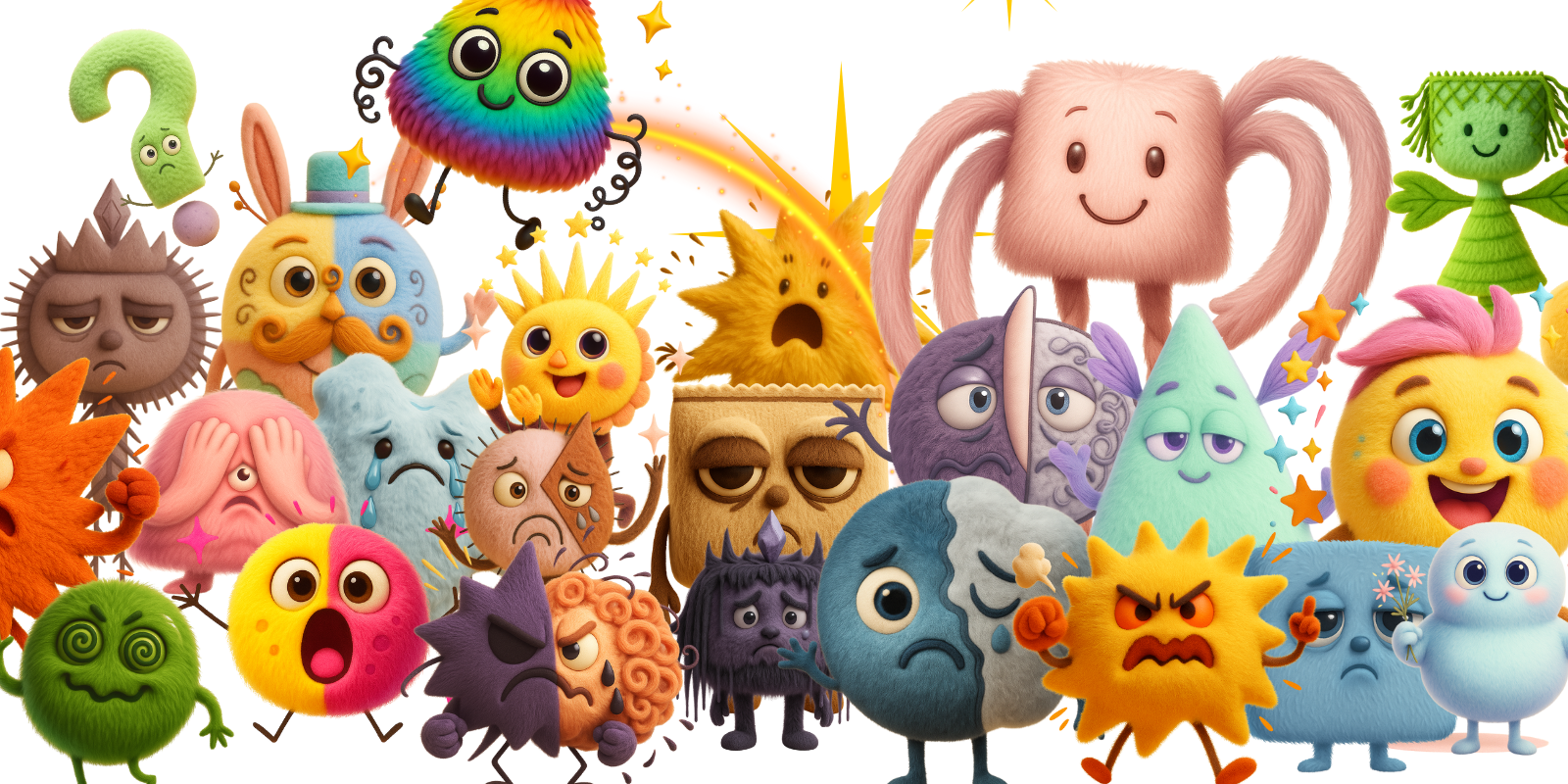
The Emps are emotion characters, each representing a specific emotion or emotional process. They offer a shared emotional language that supports curiosity, connection and understanding. At their heart is a simple idea: Emotions are not problems to fix but signals to understand.
From evidence to practice: What are The Emps?
Each Emp is designed to translate psychological concepts into something playful and meaningful. Each Emp:
- represents a specific emotion
- helps children notice how that emotion feels in their body
- models what the emotion is communicating
- supports externalisation
- encourages co-regulation and connection with adults
- normalises emotions as something we all feel
- offers simple psychologically grounded strategies
- appears in stories aligned with real developmental pathways
The Emps are designed to be woven into everyday life to help children make sense of their inner world and help adults feel more confident ‘meeting’ emotions rather than trying to fix them.

We’ve already created the characters, fact files, short videos, reflective prompts, printable resources, and practical tips. These represent the beginning of an evolving journey. Each Emp is being shaped not only by psychological theory, but by the lived experiences of children, families, teachers, and educational psychologists working with them. This is a process of co-creation, grounded in practice rather than a fixed curriculum design.
The Emps are used as visual creative and relational tools and not a scripted intervention. This is intentional. In my view emotional literacy cannot be meaningfully delivered as a one size fits all solution. It needs to be responsive, relational and embedded in everyday life.
Understanding the impact of the Emps
In practice, schools and parents are directed to our website where there are a range of free resources. The characters are presented as visuals that act as anchors which support curiosity and meaning making. As one SENDCo reflected:
“We love each of the little characters, they are so expressive and the children engage with them really well. They have opened up conversations around a broader range of emotions.”
SENCO
Emp Emotion Wheels visuals have also been particularly useful for exploring the emotions that visit us in different situations, particularly within ELSA work:
“The emotions wheels are really useful for working with children on emotions related to particular parts of school life such as friendship and learning”.
ELSA
Parents have also shared how the website supports emotional conversations at home:
“The website strategies have been great for exploring different emotions together and choosing some strategies we would like to try at home”.
Parent
At this stage evidence for The Emps is qualitative rather than quantitative, however consistent feedback points towards increased engagement, richer emotional language, and greater confidence amongst adults in supporting emotional conversations.
Why this matters for schools and professionals
Implications for The Emps are practical and wide reaching.
- Teachers gain a shared emotional language that shifts interpretation away from “behaviour problems” or “just dysregulation vs regulation” and toward emotional understanding and meaning.
- SENDCOs gain a whole class/school resource that supports emotional literacy, inclusion and access to learning.
- ELSAs gain a flexible, child friendly emotional framework that supports relational work, and emotional exploration.
- Parents gain the language and stories that make emotional conversations feel possible, safe and not overwhelming.
- Educational psychologists gain a developmentally grounded, non-clinical resource that complements existing frameworks rather than replacing them.
The Emps are not intended to replace regulation systems, they are the next step, adding greater depth, vocabulary and understanding.
An invitation and call to action
I invite the Educational Psychology community to explore the resources available on The Emps website and use them to support their practice. This includes:
- Emotion wheels (useful for 1:1 time-limited pupil voice activities and longer-term intervention)
- Emp printable cards
- Emp detective workbook (1:1 and small group investigation of emotions)
- Emp gallery (a gallery of emotions suitable for children, parents and practitioners to explore each emotion and find strategies to support them)
- Meet the Emp videos
- Emp translator cards (cards designed to support parents/carers in understanding what might sit behind behaviour and offer normalisation, guidance and practical strategies to try at home)
Looking ahead, this work will continue to grow. Emp emotions cards and Emp Detective books are currently in production, with further developments planned to include videos, immersive resources and tangible supports (i.e. plushies) to bring the characters to life.
If you would like to support the development process or find out more about how we use our tools, please do get in contact.
“Alone we can do so little; together we can do so much”
Hellen Keller
References
Anna Freud Centre. (2021). Schools in mind: Promoting mental health and wellbeing in schools. Anna Freud National Centre for Children and Families.
Brown, B. (2021). Atlas of the heart: Mapping meaningful connection and the language of human experience. Vermilion.
Education Endowment Foundation. (2021). Improving social and emotional learning in primary schools. https://educationendowmentfoundation.org.uk
Gilbert, P. (2014). The compassionate mind (2nd ed.). Constable & Robinson.
Gottman, J. M., Katz, L. F., & Hooven, C. (1996). Parental meta-emotion philosophy and the emotional life of families. Journal of Family Psychology, 10(3), 243–268. https://doi.org/10.1037/0893-3200.10.3.243
Hayes, S. C., Strosahl, K. D., & Wilson, K. G. (2016). Acceptance and commitment therapy: The process and practice of mindful change (2nd ed.). Guilford Press.
Kuyken, W., Weare, K., Ukoumunne, O. C., et al. (2013). Effectiveness of the mindfulness in schools programme. The British Journal of Psychiatry, 203(2), 126–131. https://doi.org/10.1192/bjp.bp.113.126649
Morgan, A. (2000). What is narrative therapy? An easy-to-read introduction. Dulwich Centre Publications.
NHS England / NHS Digital. Mental Health of Children and Young People in England, 2023 – Wave 4 follow up to the 2017 survey (21 Nov 2023).
Siegel, D. J. (2012). The developing mind: How relationships and the brain interact to shape who we are (2nd ed.). Guilford Press.
White, M., & Epston, D. (1990). Narrative means to therapeutic ends. W. W. Norton.