
As the autumn nights draw in and the leaves on the horse chestnut trees in my local park begin to turn from green to rust, those long, hot summer days already begin to feel like a distant memory. While September often provides an opportunity to look forward, make plans, and set aspirations for the new academic year ahead, I felt I needed to take some time to pause and reflect.
With parts of the country experiencing five heatwaves this year and the season described as provisionally the hottest on record (Met Office, 2026), this summer brought the climate emergency into a new reality for many of us in the UK.
Although I have a longstanding interest in children and young people’s views and feelings towards climate change and carried out research within this area for my doctoral thesis, I found myself reflecting on the wider implications the summer heatwaves may have had, and may continue to have, for some of the children, young people, families, and educational settings I work with.
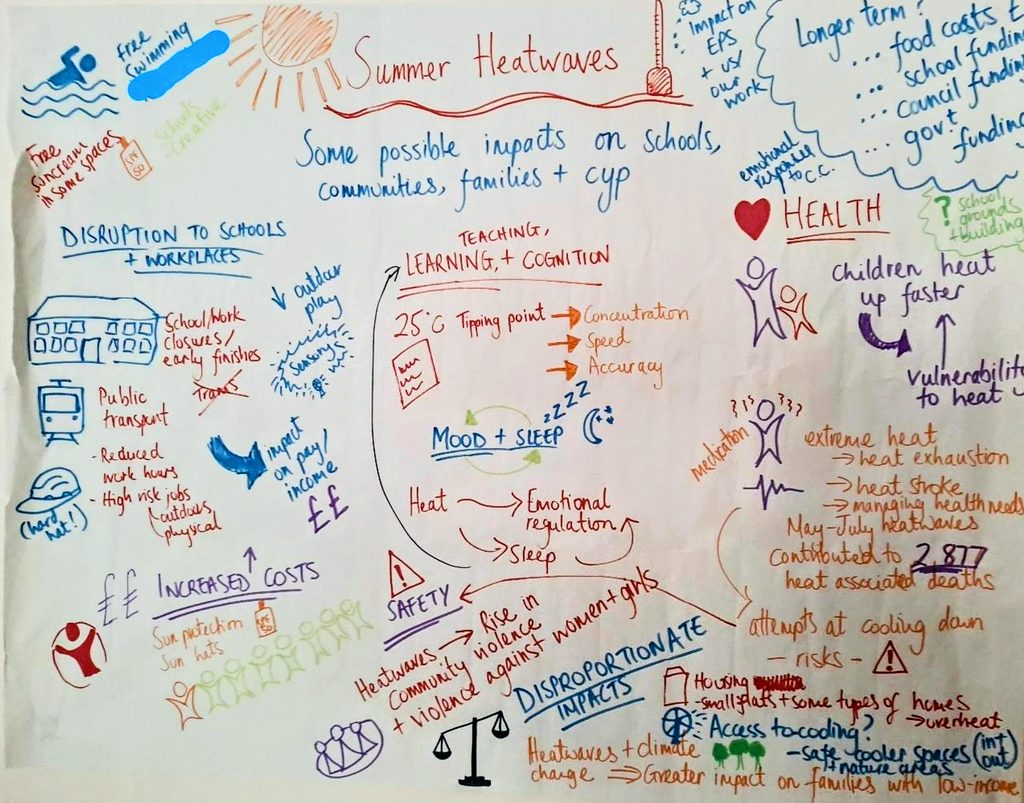
To help me make sense of my reflections, thoughts, and reading around the topic, I attempted to bring some of the different strands together into a visual:
Hot classrooms
Some consequences of the extreme heat were immediately clear. School visits on some of the hottest days quickly highlighted the inequity of access to cool spaces within and across settings whilst showcasing the creativity and flexibility of school staff in adapting spaces, timetables, and activities.
Despite such innovation, many classrooms reached uncomfortable temperatures, and I wondered how ongoing changes to usual routines and spaces were affecting children who thrive from predictability and consistency, as well as how the constant hum from numerous fans dotted about classrooms and offices were impacting students with sensitivity to environmental noise. In parts of the UK, some children’s learning was further disrupted by school closures or early finishing times in settings that struggled to maintain safe temperatures, creating a childcare issue for some families.
Research shows that as temperatures reach about 26°C, our ability to think slows and we need to exert greater energy to focus and remember information (Martin et al., 2019). Aware of my own foggy brain and slower thinking as the temperatures soared, I empathised with teachers and children attempting to continue with rapid recall and challenging problem-solving in the lessons I joined.
On some visits to settings, high temperatures and lack of shade meant that children couldn’t access outdoor spaces during social times. While essential to support children’s safety, I questioned how this restricted potential opportunities for physical and social development.
During school consultations staff and parents noted how some children were finding it more difficult than usual to regulate their emotions, and we wondered together to what extent the high temperatures and related disrupted sleep may be impacting mood and emotional regulation.
The heat beyond the school gates
While the immediate effects of high temperatures within classrooms were clear, I didn’t have to look far to see wider issues that could impact the communities I work with, including:
- Disruption to public transport networks, affecting journeys to schools and work.
- Closure to workplaces and reduced working hours with some employees unable to work at all, particularly within sectors such as construction and agriculture, where jobs are physically demanding and involve greater exposure to heat (Robinson & Dasgupta, 2026), potentially impacting household incomes for some families.
- Increased pressure on health services and an estimated 2,877 heat associated deaths recorded just within the May and June heatwaves in England (UK Health Security Agency, 2026).
- Overheating homes with limited access to cooling resources and shaded nature spaces for some families.
- And while we don’t yet have data for recent months, records show that rising temperatures and extreme heatwaves are closely linked to increases in community violence, including violence against women and girls (Mulambo et al., 2025).
Mirroring the global picture of climate change as a social justice issue, with its impacts experienced unequally across populations, the UK heatwaves and associated disruption to infrastructure and services disproportionately affected communities already experiencing social economic and health inequalities (The Equality Act review, 2026).
While I could head home after a school visit and find respite from the heat in shaded areas of my garden, paddle safely at a nearby brook, take ice from my freezer, and turn on electric fans without worrying about the running costs, I was conscious that some within my local area may not have the same experience and privileges. As I collected some of my thoughts, I also noted how my local area escaped some of the more extreme weather events including wildfires and floods experienced in other parts of the UK, each bringing further implications for their local communities.
Sharing my reflections with the EP team
Initially, the poster was intended just for myself, as a way of making sense of my thinking, but with climate change as a standing item on our monthly EPS team meetings, I thought it would be helpful to share with colleagues at our September gathering, leading to some interesting conversations and for me, a renewed energy and commitment to facilitating our service climate change interest group.
What next?
On their own, the themes in my poster and this blog can feel heavy and hopeless with the ‘So what?’ question glaring back at me.
Navigating how I can meaningfully contribute to the climate emergency response within my role as a local authority educational psychologist has not always been entirely clear to me. However, being part of a network of educational psychologists who are committed to climate conscious practice, research, training, and systems change (O’Hare, 2026) provides a source of support, hope, and inspiration. In our September meeting we shared ideas of practical steps EPS could take within their schools, settings, services, and local authorities.
When working with children and young people, I’ll consider how their family and community may have been affected by this year’s extreme weather events. As I meet with staff in schools and settings over coming weeks, I’ll be curious about how they and their communities have been impacted by this summer’s high temperatures and whether they’ve had chance to reflect on their experiences.
I’ll also ask staff about their Climate Action Plans and the school Sustainability Lead role (Department for Education, 2025) (now a DfE expectation), how they’re being supported to prepare and adapt for future extreme weather events, and whether there may be a role for EP support. I hope to be able to feed this back to the local authority’s Climate Change Team at upcoming network meetings and I’ll continue to keep the climate change conversations going within our service.
If this summer has got you thinking about how you can contribute to the climate emergency, find out more about EcoEdPsychs here or drop us an email if you would be interested in joining the group.
References and further reading
Department for Education. (2025, October 30). Sustainability leadership and climate action plans in education. https://www.gov.uk/guidance/sustainability-leadership-and-climate-action-plans-in-education
Martin, K., McLeod, E., Périard, J., Rattray, B., Keegan, R., & Pyne, D. B. (2019). The impact of environmental stress on cognitive performance: A systematic review. Human Factors, 61(8), 1205–1246. https://doi.org/10.1177/0018720819839817
Met Office. (2026, September 1). Summer 2026 provisionally hottest on record for the UK. https://www.metoffice.gov.uk/about-us/news-and-media/media-centre/weather-and-climate-news/2026/summer-2026-provisionally-hottest-on-record-for-the-uk
Mulambo CH, Thakur R, Mathew S. (2025). Hot Weather and Violence Against Women: A Global Scoping Review. International Journal of Environmental Research and Public Health. 22(7):1069. https://doi.org/10.3390/ijerph22071069
O’Hare, D.P. (2026, June 26th). The heat, the climate crisis and us. [Online forum post]. EPNET. https://www.jiscmail.ac.uk/cgi-bin/wa-jisc.exe?A2=ind2606&L=EPNET&P=R2890&X=637766BE03C6D58AA1&Y=hello%40edpsy.org.uk
Payton, J. (2023). “Hope isn’t actually lost yet”: A reflexive thematic analysis exploring young people’s views and feelings towards climate change. [Thesis] https://repository.nottingham.ac.uk/entities/publication/9006188f-8e2f-4e6f-9d23-f775e3b73252
Robinson, E. & Dasgupta, S. (2026). Climate change’s heat tax on the UK’s labour force and economy. Technical Report. Grantham Research Institute on Climate Change and the Environment. https://doi.org/10.21953/researchonline.lse.ac.uk.00140309
The Equality Act Review (2026, September 16). Feeling the Heat: How Inequality Shapes Heatwave Experiences. https://www.equalityactreview.co.uk/post/feeling-the-heat-how-inequality-shapes-heatwave-experiences
UK Health Security Agency (2026). Interim heat mortality monitoring report, England: May and June 2026. https://www.gov.uk/government/publications/interim-heat-mortality-monitoring-report-england-may-and-june-2026