Consultation is one of the five core functions of EP practice. For many EPs, consultation is part of daily practice.
Defined 25 years ago as “a voluntary collaborative nonsupervisory approach established to aid the functioning of a system and its inter-related systems” (Wagner 2000, p. 11) our experience has been that within day-to-day practice, the term ‘consultation’ has had different connotations for different EPs working in different service contexts. This ambiguity made training new EPs in consultation difficult.
Why did we develop this framework?
A local authority EPS commissioned research from the Doctorate in Educational and Child Psychology programme at the University of Manchester, to develop a coherent and contemporary model of consultation for trainee educational psychologists. This led to work by Royle and Atkinson (2025a, b) examining local authority consultation policies and exploring what experienced EPs thought should be included in TEP consultation training. This body of research led us to develop a definition of consultation, recently refined, in consultation with our Year 1 Manchester trainee colleagues as follows:
Consultation refers to collaborative, problem-solving conversations, typically with adults who support children and young people. It recognises and values the expertise of the consultee and aims to build capacity and develop solutions. Whether conducted as a formal consultation meeting or integrated within broader educational psychology practice, it strives to offer a culturally sensitive and psychologically safe thinking space.
The ECHOES framework
From the research findings, we wanted to develop a memorable framework which could be easily remembered or potentially shared with consultees. We’d therefore like to present the ECHOES model of consultation. The acronym stands for
- Empathy and deep listening – acknowledging the importance of hearing and understanding the consultee’s experience
- Collaboration – working together in partnership, rather than the EP holding the expertise, ideas and solutions
- Honouring expertise – recognising that the consultee is the expert in their own context, whether this be a parent’s home or a teacher’s classroom, and that they are the person best placed to offer realistic solutions
- Open enquiry – genuine curiosity to seek to understand the presenting issues, asking open questions and allowing the consultee to prioritise the agenda
- Evaluation and follow up – wherever possible trying to check-in with the consultee afterwards to assess the usefulness of the conversation and identify any further needs.
- Synthesising and reformulating – helping the consultee to assimilate information, reframe priorities and concerns and agree next steps
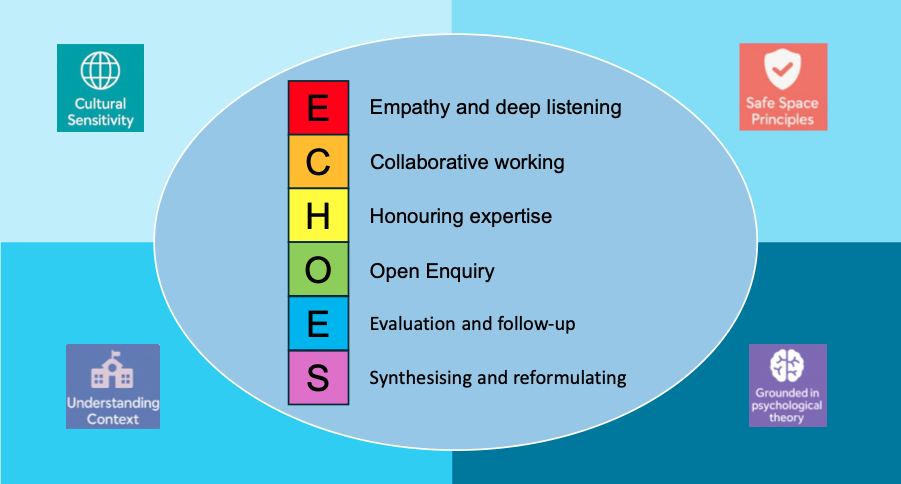
These are not necessarily sequential, but all are important to consider for effective consultation
The context for ECHOES
While the ECHOES acronym details the skills and tasks of consultation, the boxes around provide the broader practice philosophy. We are aiming for consultation to provide a safe, supportive space for consultees to share their concerns and work in partnership.
Cultural sensitivity and humility are key across different axes of diversity (e.g. race, religion, status, education, gender, social class), when working with people from varied backgrounds and in different roles, and we want the framework to align with social justice principles. We are seeking to understand the wider context in which the consultation is taking place, and the wider systems that are at play (e.g. school improvement, Ofsted, budgets). Finally, we are looking to apply psychology and scrutinise our own practice from an evidence-based perspective.
A work in progress
While the framework is evidence-informed, we see it as a starting point, and it is yet to be tried and tested. We will have ongoing discussions with University of Manchester TEP colleagues, tutors and placement partners with a view to reviewing and refining the model. We are also planning to conduct research with TEPs later this year to gather feedback and evaluate the framework’s effectiveness in practice.
In the meantime, we would invite colleagues to freely use the model in their EPS, using the reference and would welcome any feedback about how the framework is being used, and how it could be further developed.
Reference for this blog: Royle, B., Atkinson, C. Harding, E. & Kuria, E. K. (2025). ECHOES – a University of Manchester framework to help trainee EPs develop skills for consultation. Edpsy.org.uk
References
Kuria, E. K., & Kelly, C. (2023). Exploring social justice principles within an educational psychology service. Educational Psychology in Practice, 39(4), 403-418. https://doi.org/10.1080/02667363.2023.2226857
Royle, B., & Atkinson, C. (2025a). Consultation policies in UK local authority educational psychology services: a scoping review of practice. Educational Psychology in Practice, 41(3), 296-316. https://doi.org/10.1080/02667363.2025.2487831
Royle, B., & Atkinson, C. (2025b). Identifying core components of consultation for trainee educational psychologists and initial training. Educational Psychology in Practice, 41(3), 374-391. https://doi.org/10.1080/02667363.2025.2497038
Wagner, P. (2000). Consultation: Developing a comprehensive approach to service delivery. Educational Psychology in Practice, 16(1), 9–18. https://doi.org/10.1080/026673600115229